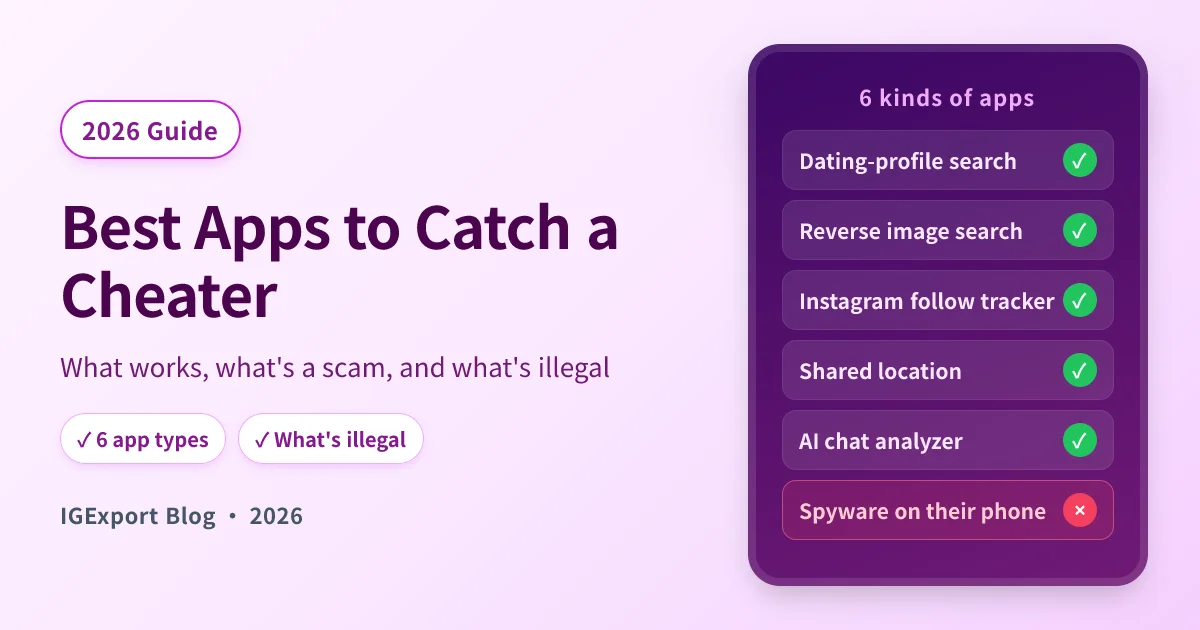
If you're searching for an app to catch a cheater, here's the honest version first: no app can prove someone is cheating. What apps can do is surface specific, checkable facts — a dating profile that shouldn't exist, a photo showing up somewhere unexpected, a new account your partner started following — and some of them do that legally, while others can land you in legal trouble.
This guide sorts the apps people actually use into six categories, and for each one covers what it really shows, what it costs, whether it needs your partner's phone, and whether it's legal to use on a partner.
Quick comparison
| App type | What it can show you | Needs their phone or password? | Legal to use on a partner? | Examples |
|---|---|---|---|---|
| Dating-profile search | Whether a matching profile appears on a dating app | No | Generally yes (public data) | Cheaterbuster, CheatEye |
| Reverse image search | Where their photos appear online | No | Yes | Google Lens, TinEye, Social Catfish |
| Social activity tracker | Who they recently followed on Instagram | No | Yes (public accounts) | Recent Follow |
| Shared location | Where their phone is | They have to turn it on | Only with their consent | Find My, Life360 |
| Chat analyzer (AI) | An AI opinion on screenshots you upload | No | Yes (your own chats) | Cheater AI |
| Spyware / "monitoring" apps | Their texts, calls, location | Yes — installed on their phone | ⚠️ Often illegal without consent | Marketed as "parental control" or "spouse monitoring" |
The first five work from data you're allowed to see. The last one doesn't — and it's the one that shows up most often in search results.
1. Dating-profile search apps
What they do: You enter a first name, approximate age, and city (sometimes a photo), and the service looks for a matching profile on a dating app — most often Tinder.
What they can show: A profile photo, bio, age, rough distance, and sometimes a "recently active" indicator. They can't show messages, matches, or swipes.
Cost: Typically paid per search. Cheaterbuster (formerly Swipebuster), the best-known one, has been reported at around $18 per search with bundle discounts.
Limits worth knowing: Results depend heavily on the details you enter. A common first name, a vague location, a nickname on the profile, or a partner using Tinder's Passport feature to set a different city can all produce a miss — or a match that turns out to be a stranger. Treat a result as something to verify, not a verdict.
Best for: "Is my partner still on dating apps?"
2. Reverse image search
What it does: You upload a photo of your partner (or one from their profile), and the search engine looks for the same or similar images elsewhere.
What it can show: Other accounts, dating profiles, or pages using the same photos. It's also the fastest way to check whether someone you met online is who they claim to be.
Cost: Google Lens and TinEye are free. Paid people-search services like Social Catfish go further but charge per search or by subscription.
Limits: It only finds images that are publicly indexed. A photo used only inside a dating app usually won't show up.
Best for: Catfish checks and finding a second profile that reuses the same pictures.
3. Social activity trackers (Instagram follows)
What they do: Instagram doesn't sort anyone's Following list by time, and it doesn't tell you when someone follows a new account. A follow tracker reads a public account's following list and puts it back in order, newest first.
What it can show: Who your partner recently started following — the signal people most often ask about when they say "he keeps following girls on Instagram."
What it can't show: Messages, likes history, or anything inside a private account you haven't been approved to follow. Any app that claims otherwise is a scam.
Cost: Recent Follow by IGExport is free to download; the full, complete following history is an in-app purchase.
Legal: You're looking at the same public list anyone can open in the Instagram app — it's just sorted properly. There's no login to their account and they aren't notified.
Best for: "Who is he following lately?" — see how to see who your boyfriend recently followed for the full walkthrough.


4. Shared location apps
What they do: Apple's Find My, Google's location sharing, and apps like Life360 show where a phone is — after the owner turns sharing on.
What it can show: Where they are, and on some apps, where they've been.
Legal: Fine when both of you agree to share. Secretly enabling it on their phone, or hiding a tracker in their car, is a different story — many US states treat covert location tracking as a crime, and Google Play's own policy doesn't allow monitoring apps to be used on a spouse even with permission.
Best for: Couples who already share locations by agreement. It's not a covert tool, and shouldn't be used as one.
5. AI chat analyzers
What they do: You upload screenshots of your own conversations with your partner, and an AI points out patterns — reply times, shifts in tone, vague answers — that it considers "red flags."
What it can show: An opinion. It can help you notice something you'd been explaining away, but it's pattern-matching on text, not evidence of anything.
Cost: Usually a weekly subscription after a short trial.
Best for: Getting a second read on a conversation that's been bothering you.
6. Spyware and "monitoring" apps — the one to avoid
These are the apps that promise to show you your partner's texts, calls, WhatsApp, and location. They work by being installed on the other person's phone, usually without their knowledge.
In the US, installing this kind of software on another adult's phone without consent can violate federal wiretapping and computer-access laws as well as state laws — and evidence collected that way can be excluded in court or used against you. Many of them are marketed as "parental control" — which is also the only kind of monitoring Google Play allows.
If your plan requires getting into their phone or their password, stop there. The same goes for logging into their Instagram or email with a password you happen to know.
What no app can do
- Prove cheating. Every tool above shows a fact that needs context. A follow, a profile, or a photo can have an innocent explanation.
- Read someone's private messages. DMs on Instagram, WhatsApp, and Snapchat are private. Services that claim to reveal them are scams — or spyware.
- Open a private account. Unless you've been approved to follow it, no legitimate tool can show what's inside.
Before you use any of these
Worth saying plainly: if you're at the point of searching for an app to catch a cheater, something already feels wrong, and that feeling deserves attention whatever an app says. Use a tool to answer one specific question — is he on Tinder? who did he just follow? — then decide what you actually want to ask him. If what you're seeing is closer to micro-cheating than an affair, that conversation matters even more, because what counts as crossing a line is something only the two of you can define.
If you're thinking about divorce or legal action, talk to a family lawyer before you start collecting anything. How evidence is gathered matters as much as what it shows.
Frequently asked questions
Is there a free app to catch a cheater?
Partly. Reverse image search (Google Lens, TinEye) is free, and Recent Follow is free to download for checking who a public Instagram account recently followed. Dating-profile search services and AI chat analyzers are almost always paid. Anything "free" that promises to show someone's messages is a scam.
Is there an app to see who my partner is texting?
Not legally, unless they agree. Apps that show another person's texts have to be installed on their phone, and doing that without consent can break wiretapping and computer-access laws.
Is it legal to put a tracking app on my spouse's phone?
Generally not without their consent. Being married doesn't give you the right to install monitoring software on another adult's device. Shared location that both of you turn on is fine.
Do cheater finder apps actually work?
Sometimes. Dating-profile search tools depend on exact details — first name, age, location — and can miss profiles that use a nickname or a different city, or return someone who just looks similar. Use a result as a lead to verify, not as proof.
How can I tell if my boyfriend is following other girls on Instagram?
Instagram's Following list isn't in chronological order, so the top of the list doesn't mean "newest." A follow tracker like Recent Follow sorts a public account's follows newest-first. Here's the step-by-step guide.
Related reading
- See who someone recently followed — the Recent Follow app (iOS & Android)
- How to See Who My Boyfriend Recently Followed on Instagram
- Recently Followed on Instagram: The Complete Guide (2026)
- Instagram Recent Following: How to See It in Order
- How to See Recently Followed on a Private Instagram Account